
Clinical operations
Daily Work Action Center
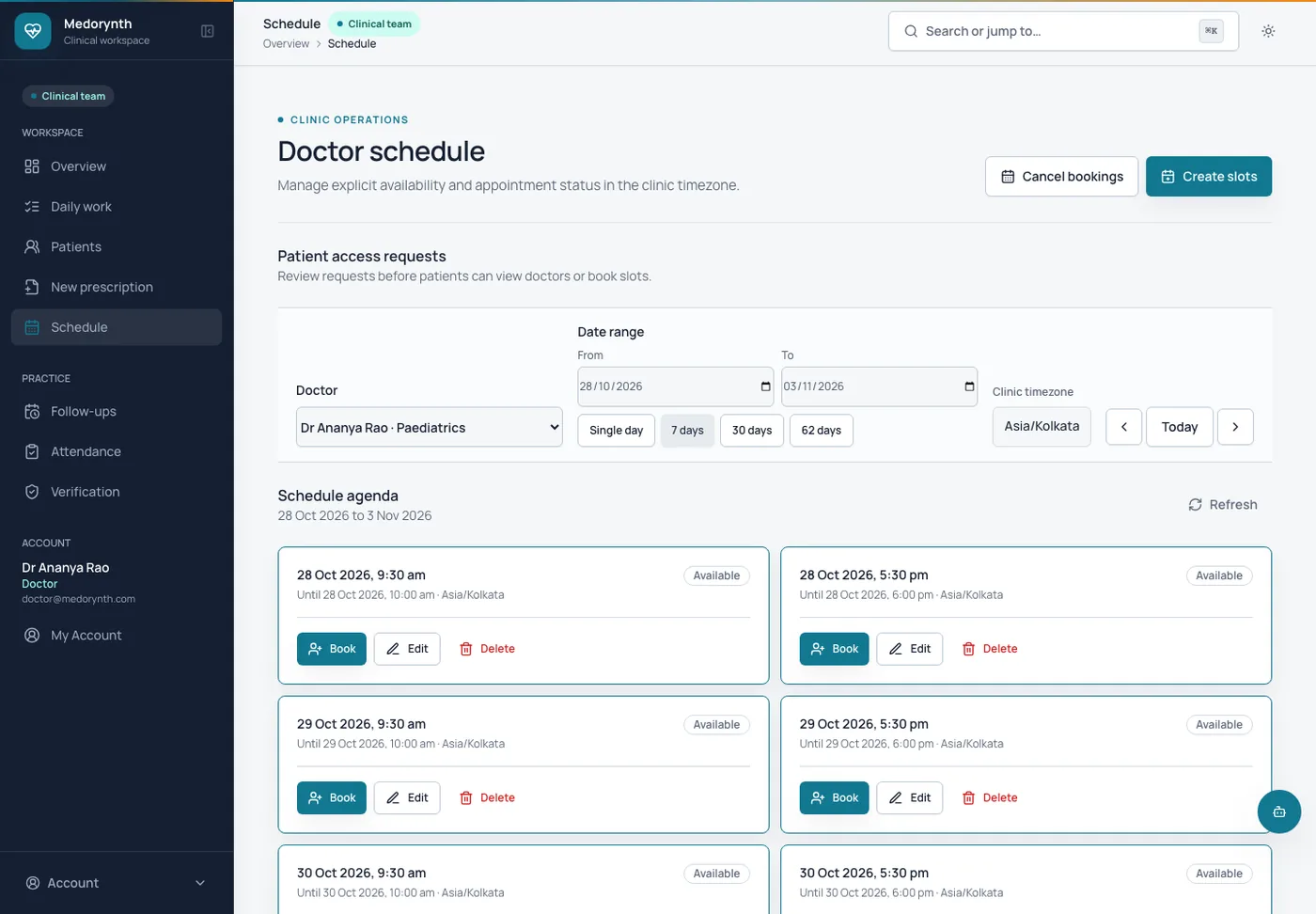
One prioritised queue across reviews, follow-ups, appointments, tasks, messages and care gaps — with saved views and role-scoped access.
Triage lensSaved viewsRole-scoped
Medorynth is a tenant-isolated clinic operations platform for patients, doctors, clinics and platform teams. A roadmap that would normally take a 2–3 person team about three months shipped in one builder-month — with AI doing the acceleration and humans keeping the judgment.
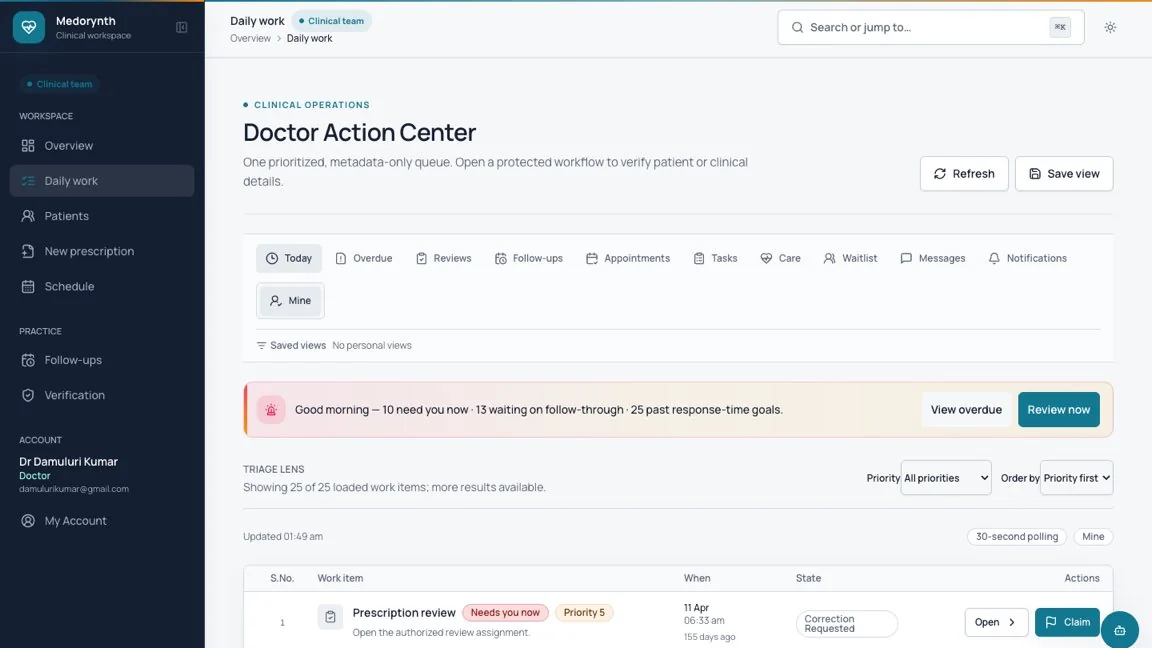
Product screenshot: Doctor Daily Work Action Center.
The comparison is deliberately simple: two to three developers for roughly three months is 6–9 developer-months. Medorynth moved from foundation to a working, tested platform in about one builder-month of effort.
Calendar time moved from roughly three months to one. Effort compares developer-months, not lines of code.
~3× faster calendarRepository snapshot used for this case study. Counts describe the Medorynth codebase, not a productivity score.
The tabs below are real screens from the live demo. The platform is organised around what each role needs to do next — not around a generic dashboard.
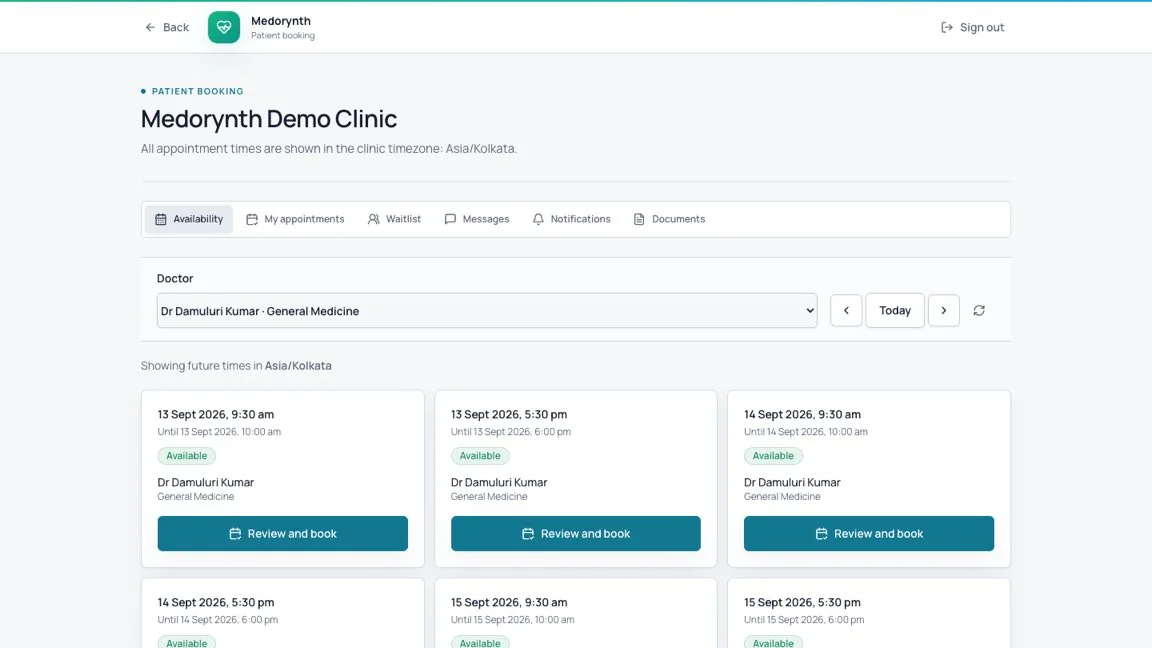
Patients discover approved clinics, request access, view real availability and self-book. Family members, waitlists, secure messages, reminders and documents stay attached to the same care journey.
The Daily Work Action Center turns the day into one prioritised queue: reviews, follow-ups, appointments, tasks, messages and care gaps. The schedule, patient record and prescription workflow sit one click away.
Clinic teams get scoped access to patients, staff invitations, assignments, billing, insurance and revenue views. Front desk, nurses and doctors each see only what their role permits.
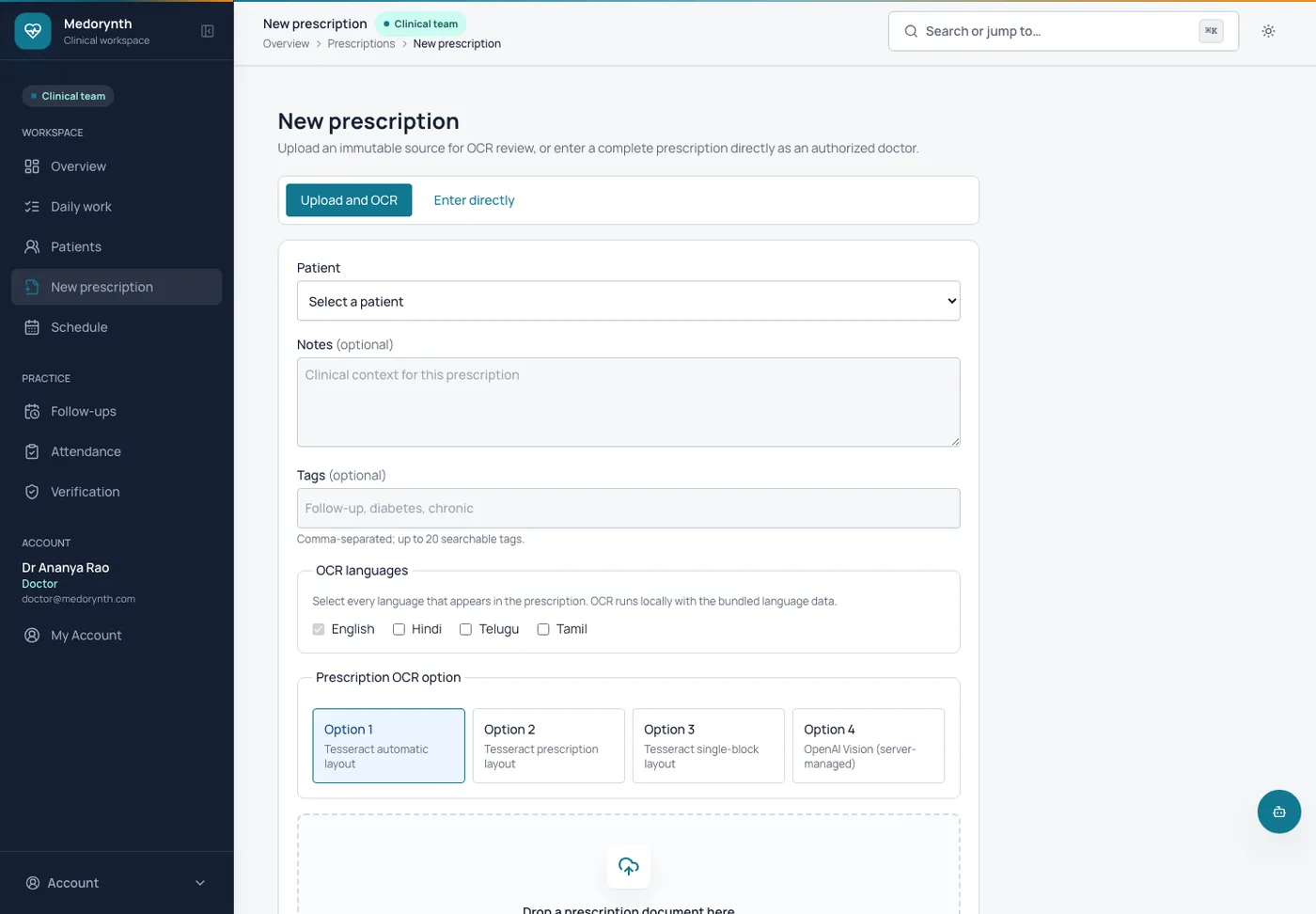
Doctors upload a prescription image, choose one of four OCR options, then review what the machine read. Options 1–3 run locally with Tesseract WASM in English, Hindi, Telugu and Tamil; Option 4 uses OpenAI Vision through a server-managed Edge Function.
Super admins manage tenant lifecycle, licensing plans, entitlements and feature controls from one audited surface. Every commercial action leaves an audit event; every tenant boundary is enforced in PostgreSQL.
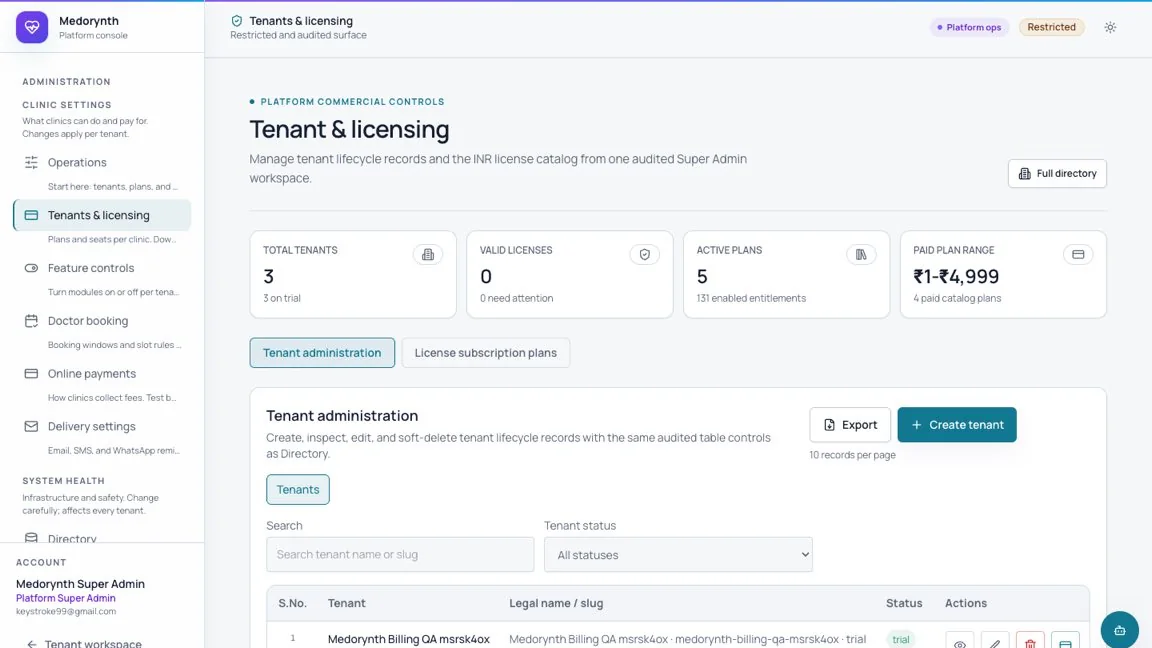
The screens are the surface. Underneath are governed workflows, explicit permissions and clinical-state rules that make the product safe to operate.
One prioritised queue across reviews, follow-ups, appointments, tasks, messages and care gaps — with saved views and role-scoped access.
Real availability in the clinic's timezone, invitations, waitlists and reminders — without exposing the clinical record.
Local WASM keeps options 1–3 in the browser. Option 4 sends a bounded image to a governed function. A clinician still finalises every word.
Rows are scoped to the clinic. RPCs, RLS policies and Edge Functions enforce the boundary — the interface is never the security model.
Invoices, payments, insurance and revenue views sit next to the clinical work — not in a separate spreadsheet with a different source of truth.
The workflow was deliberately boring: one bounded prompt, repository evidence, executable checks, browser validation, then human review. That is what made the speed repeatable.
Write the acceptance criteria, authorization model and failure states before any code. The agent receives a boundary, not an ambition.
A repo-aware coding agent gets one prompt at a time: schema, RPC, UI or test — never the whole roadmap in one pass.
The agent drives the real journey with Playwright: happy path, denied path, responsive state, and visible console or network failures.
Every defect goes back through the same journey. The progress ledger records what passed, what failed and what remains an external gate.
Architecture, clinical safety, data protection and production release stay with people who can be accountable for them.
agent  prompt 07 · prescription OCR review
read   21 prompts · architecture · RLS rules
write  migration · RPC · Edge Function · UI
check  vitest · 122 test files        ✓
check  pgTAP structure               ✓
run    playwright · doctor journey   ✓
find   stale review lease            !
fix    revalidate · ledger updated   ✓
gate   clinician review + release    HUMAN
Workflow assembled from the repository's agent QA and 21-prompt runbooks.
Reads the repo, follows AGENTS.md, writes the smallest coherent change.
Drives the live app, checks every affected role, records the evidence.
Sequential prompts with prerequisites, acceptance criteria and rollback boundaries.
OpenAI Vision and Tesseract WASM behind a clinician review gate.
A static Next.js export, a Supabase control plane and one governed document pipeline. No bespoke infrastructure to babysit, no hidden server to widen the attack surface.
Medorynth's speed is bounded by explicit safety decisions. Real patient data has release gates for a reason.
RLS and server-side RPCs scope every record to its clinic.
OCR stays unreviewed until a clinician finalises it.
Finalised prescriptions and signed encounters keep their source evidence.
Tenant lifecycle, licensing and clinical actions leave an audit trail.
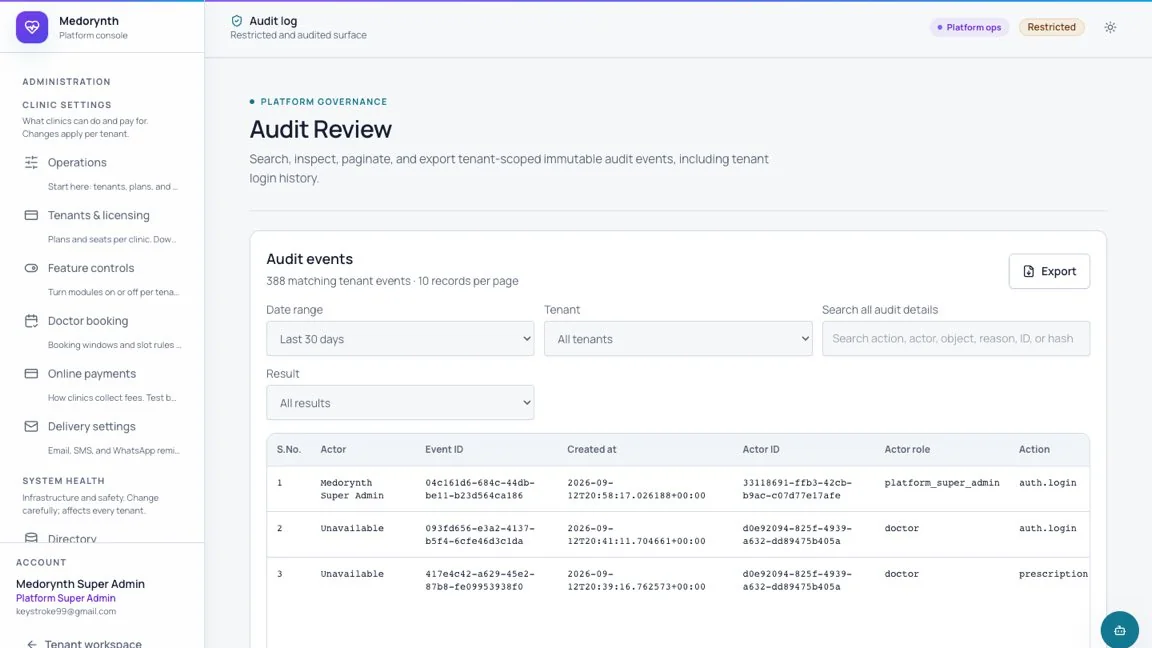
AI can write the code. It cannot sign the release.
Production readiness: live use requires the repository's release gates, provider agreements, security review and clinical sign-off.
A rough shape of the month, not a minute-by-minute claim. The point is the sequence: foundation, clinical core, platform depth, then proof.
Identity, personas, tenant membership and the design system. The route manifest and first RLS policies set the boundaries everything else inherits.
Scheduling, patient records, the Daily Work Action Center, prescription authoring, follow-ups and clinical tasks. The product starts to feel like a clinic.
OCR options, licensing, billing, audit, notifications and delivery controls. The platform grows its commercial and governance surfaces.
Unit tests, Playwright journeys, architecture guards, documentation and deployment. The release conversation is grounded in evidence.
Twenty-one prompts is the smallest safe execution chain for this repository.Medorynth implementation runbook
The ~85% figure compares 6–9 developer-months with ~1 builder-month. The test suite and release gates are the evidence that matters.
Medhantara builds the system, the guardrails and the delivery loop — then uses AI to move faster inside them.
Case study based on the Medorynth repository and live product screenshots.